At first glance, mobile growth looks simple.
An ad goes live.
Users install.
Revenue follows.
But behind every successful app lies a complex system, one made of platforms, signals, data flows, and feedback loops constantly talking to each other.
This is the mobile marketing ecosystem.
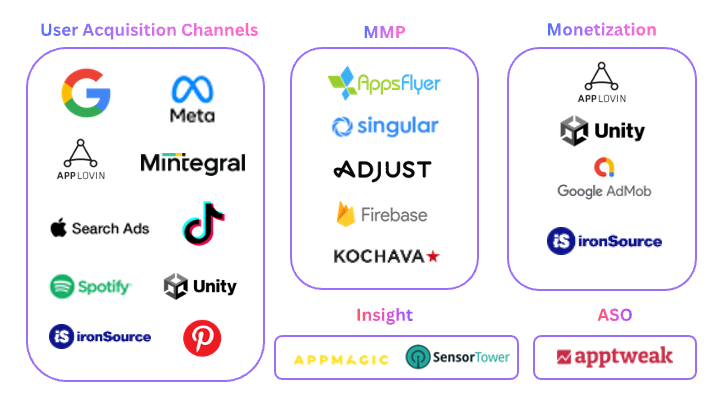
It is not a list of tools.
It is a system of roles.
And each platform exists for a very specific reason.
1. User Acquisition Platforms: Where the Journey Begins
Every ecosystem starts with discovery.
User acquisition platforms are where apps first meet users, often before users even know they are looking for a solution.
But not all UA channels serve the same purpose.
Google Ads – Capturing Intent
Google operates on intent.
When users search, they are already expressing need. Google Search and Google Play inventory allow apps to appear exactly at that moment.
Its strength lies in:
- High-quality users
- Strong conversion rates
- Massive global scale
In the ecosystem, Google acts as the demand harvester — capturing users who are ready to act.
Meta (Facebook & Instagram) – Creating Discovery
Meta works differently.
Users are not searching. They are scrolling.
Meta’s power lies in:
- Audience modeling
- Interest and behavior signals
- Creative-driven storytelling
Meta introduces apps to users before intent exists.
In the ecosystem, Meta plays the role of demand creator.
TikTok – Driving Momentum
TikTok is energy.
Short-form video, creator-style content, and trend-based discovery allow apps to spread fast, sometimes explosively.
Its strength is not precision, but momentum.
TikTok excels at:
- Rapid learning
- High engagement
- Creative virality
In the ecosystem, TikTok is the accelerator, capable of turning small signals into massive reach.
Apple Search Ads – Meeting Users at the Decision Point
Apple Search Ads sits at the final step of intent.
Users are already inside the App Store, searching for solutions.
That makes ASA:
- Highly efficient, high retention rate and ROAS users
- Extremely intent-driven
- Critical for iOS performance
In the ecosystem, ASA acts as the closer – converting intent into installs.
Gaming Ad Networks (AppLovin, Unity Ads, ironSource, Mintegral)
These platforms operate within mobile games themselves.
Their inventory is immersive, native, and scale-driven.
They are especially powerful for:
- Gaming apps
- Reward-based engagement
- Performance-driven UA
In the ecosystem, gaming networks provide scale and volume, feeding the system with large numbers of users.
New Players
There are some new players in the game, like Spotify and Pinterest, which have recently rolled out app install solutions.
These platforms are perfect testing grounds for lifestyle and utility apps, letting marketers experiment and eventually contribute more success stories to the market.
And that’s not even mentioning the millions of other UA tactics out there, influencer partnerships, referral programs, affiliate marketing, and more.
Together, these channels give marketers plenty of ways to grow, test, and diversify beyond the usual paid networks.
2. Mobile Measurement Partners: The Source of Truth
Once users install, something else takes control.
The Mobile Measurement Partner.
MMPs do not acquire users.
They do not generate revenue.
But they connect everything.
Their role is to:
- Attribute installs correctly
- Track in-app events
- Measure retention, revenue, and ROAS
- Feed data back to UA platforms
Without MMPs, every platform speaks a different language.
With MMPs, the ecosystem speaks one.
They are the translator of mobile growth.
3. Monetization Platforms: Turning Usage into Value
Growth without monetization is fragile.
Monetization platforms determine whether user acquisition can continue — or must stop.
They manage:
- Ad serving
- Bidding
- Mediation
- Revenue optimization
Every ad impression, purchase, or subscription becomes a signal.
That signal flows back into the ecosystem as revenue data.
Monetization is not the end of the journey.
It is the validation of it.
4. ASO: The Silent Multiplier
ASO rarely gets attention — yet it amplifies everything.
By improving store visibility and conversion rates, ASO:
- Lowers effective CPI
- Increases organic installs
- Strengthens paid performance
ASO does not replace UA.
It enhances it.
In the ecosystem, ASO acts as a multiplier, making every paid effort more efficient.
5. Market Intelligence: Seeing Beyond Your Own App
While MMPs show internal performance, insight tools show the outside world.
They reveal:
- Market trends
- Competitor strategies
- Monetization benchmarks
- Creative patterns
These platforms don’t operate campaigns; they inform decisions.
In the ecosystem, they function as the strategic compass.
How Everything Connects
When the ecosystem is connected, data flows continuously:
- UA platforms bring users
- MMP attributes and tracks behavior
- In-app events generate insights
- Monetization produces revenue
- Revenue feeds back to MMP
- MMP sends value signals to UA algorithms
- UA optimizes toward quality, not volume
At the same time:
- ASO improves conversion
- Insights guide direction
- Creatives evolve based on performance
Nothing works in isolation.
Everything listens.
Everything adjusts.
Conclusion: Growth Is a System, Not a Channel
The biggest misconception in mobile marketing is believing growth comes from finding the “best channel.”
There is no best channel.
There is only a well-orchestrated ecosystem.
The companies that scale successfully are not those spending the most, but those connecting their systems the best.
Because in the end, mobile growth is not about buying installs.
It is about building a system where every platform knows its role and plays it in harmony with the others.
That is how sustainable growth is created.
Leave a Reply